
Build Morgan County's Backward Deed Timeline
Start with the newest deed matching the parcel's legal description. Copy what the record actually says. That grantor then becomes the grantee you hunt for in the earlier conveyance.
| Transfer date | Grantor to grantee | Deed type | Book/page |
|---|---|---|---|
| Newest matching record | Prior owner to present grantee | Warranty, quitclaim, administrator, or other conveyance | Copy exactly from index |
| Prior acquisition | Earlier grantor to that prior owner | Record the stated instrument | Follow cited prior deed when supplied |
| Earlier link | Repeat with name variants | Do not skip corrections or estate deeds | Match the same legal description |
| Manual-book era | Continue through historical indexes | Preserve abbreviations as written | Ask Clerk or Archives about images |
The GSCCCA index sets the standard modern route for deed records. The Morgan Local Land Search, the Clerk's books, and the Archives extend the hunt into older local holdings.
Choose the Right Morgan County Cutoff Year
Two coverage claims describe different systems. GSCCCA states that every Georgia county offers standardized deed-index data from January 1, 1999 onward. The Morgan Clerk's page goes much further. It reports deeds and images back to 1806, plus Historical Index Books covering 1806 through 1833. Keep those claims separate. Neither date erases the other.
Start online for a modern chain. When an index stops, move to the local historical books or ask for help. The Clerk's Records Room at 384 Hancock Street in Madison allows free research, printed copies cost money, and staff do not perform legal research.
Know the index. A GSCCCA search reaching at least 1999 does not mean Morgan's earlier deeds vanished. Continue through local books, images, and Archives.
Enter Morgan's Local Historical Land Search
The Clerk's Morgan Local Land Search moves a citation into indexed material.
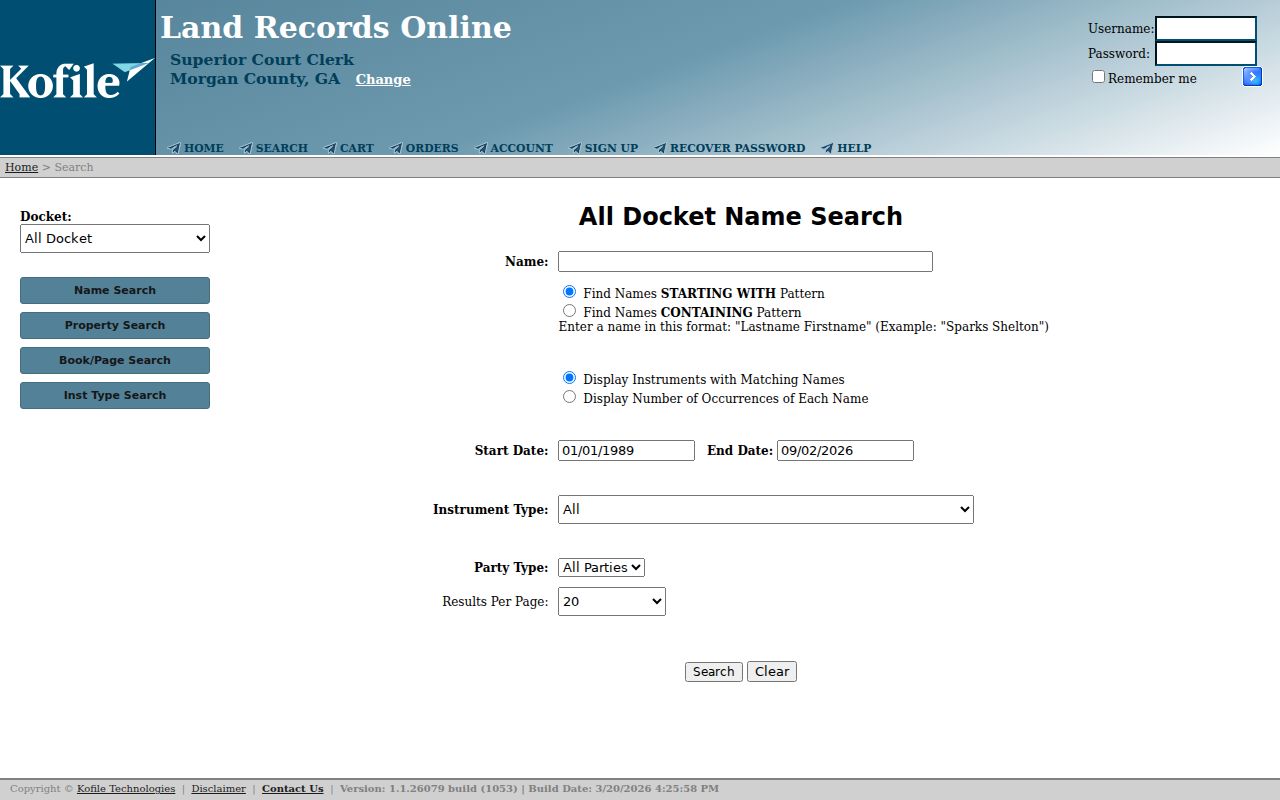
Use this local route beside the statewide GSCCCA search, never instead of it. The two systems answer different questions. One reaches deep into local history; the other marks the standardized statewide cutoff, so tag each former-owner link with its source.
Walk Morgan County's Grantor-Grantee Chain Backward
Anchor everything in the current parcel number and legal description. The recorded chain still begins with the latest matching deed. Search names broadly first, then narrow the results with Morgan County, date, deed type, subdivision, acreage, district, land lot, and book/page.
- Find the current acquisition deed with today's apparent owner as grantee.
- Record its grantor, legal description, instrument type, date, and book/page.
- Search that grantor as a grantee to locate the earlier acquisition.
- Repeat until the chosen date, a documented gap, or the manual historical books.
- Grantor and grantee
- The conveying party and receiving party stated in a deed.
- Chain of title
- The ordered sequence of instruments affecting the same land.
- Reverse index
- An index organized to find a party in the opposite deed role.
- Quitclaim and warranty deed
- Different conveyance forms that must be recorded as labeled, not treated as equivalent promises.
Match Morgan Legal Descriptions, Not Names Alone
Names repeat and change. They also appear in many roles across a chain. Continuity comes from the land description. Compare subdivision, lot, block, unit, phase, acreage, district, land lot, roads, creeks, adjoining owners, and the cited prior deed. Rural tracts often rest on metes and bounds rather than a modern address.
An easement or right-of-way may sit in a separate record that later deeds never repeat, so search the parties and plat notes as well as the main conveyance. Mark any gap unresolved rather than smoothing it over.
Note: Preserve initials, spelling variants, punctuation, and entity suffixes, since historical indexes may file one party under several forms.
Find Morgan Plats and Subdivision Origins
The Clerk's Real Estate Division reports plats back to 1921. A plat maps the land itself: lots, blocks, streets, rights-of-way, easements, common areas, drainage, and adjoining tracts. It also records the survey date. Start with the subdivision name. Then try phase, surveyor, developer, dedication, vacation, replat, or plat book/page.
A plat fixes geography, not ownership. Only a conveyance that incorporates it proves the former owner. For early land-lot or grant context, the Georgia Archives loose plats and the Surveyor General collection cover 1755 through 1909.
Branch Morgan's Chain for Estates and Foreclosures
A tidy warranty-deed run is the hope, never the guarantee. Quitclaims, administrator deeds, sheriff or foreclosure deeds, survivorship deeds, correction deeds, and probate orders all create branches. Log each instrument type. Decide what role it played before moving back another step.
Morgan Probate Court holds the estate and will records that explain a representative's authority. A death record is only a lead, not proof of title. Match the estate authority to the executor or administrator deed. Then connect it to the recorded conveyance.
Use Morgan Archives for the Pre-Digital Chain
Morgan County Archives keeps nineteenth- and early twentieth-century deeds and land titles, wills, estates, inventories, appraisements, guardianships, marriages, and tax digests. Those holdings can bridge a missing index entry. They also explain transfers that passed through an estate.
Requests work best with a defined target. Give a name, date span, book/page, parcel description, or record type. The Archives can also say which early books survived, moved, or were copied after changes in courthouse custody.
Log Every Morgan County Chain Break
A chain worksheet earns its keep. Record the deed date, grantor, grantee, instrument type, legal description, book/page, cited prior deed, image status, and any release or exception. Older indexes demand more detail. Add the index-book page, spelling variants, abbreviated instrument labels, and whether a matching image exists.
Some breaks announce themselves. Stop and log one when the land description changes without explanation, a cited deed is missing, two same-name parties refuse to separate, an estate lacks authority, or a release has no lien. A gap is a finding, not a failure. Never assume the most plausible person was the owner of record just to close it.
Carry Morgan County Tax Digests as Supporting Leads
Tax digests in the Morgan Archives name the taxpayer and the assessed holding for a given year, so they help test whether a name stayed tied to land between recorded events. That matters most when early deed indexing gets difficult. They are not conveyances. No digest substitutes for the deed chain.
Log the digest year. Note the district, spelling, description, and value columns. Then run that name through the matching grantor and grantee indexes, because the digest narrows the window while the recorded instrument supplies the transfer evidence.
Research Morgan's Courthouse Fire Without Assuming Loss
Morgan County formed from Baldwin County in 1807. Madison became the seat the next year. The first courthouse followed in 1809. County history reports that fire destroyed the original courthouse in 1917, and that fact creates a custody question rather than proof every earlier deed was lost.
The Clerk's claim of deed depth to 1806 shows why the question of surviving books needs a direct answer. Ask which original books remain. Ask about copied indexes, reconstructed material, image coverage, and where each item now resides.
Search Morgan Newspapers for a Missing Prior Name
The Georgia Historic Newspapers Morgan collection covers local issues from 1842 through 1878. No deed index catches every name. Search sheriff's sales, estate notices, tax sales, roads, business names, and property descriptions in those pages.
A newspaper item is a lead. It is not the conveyance. Log the title, issue date, page, parties, property wording, and stated sale date, then verify the event in a deed book, court file, probate record, or tax digest.
Know How Far Morgan County Former Owners Go
The local deed claim begins in 1806. That is just before county formation. Surveyor General plats can push land context earlier than the county chain. A modern street address will not reach that far, so shift to names, book and page, acreage, adjoining owners, district and land lot, creeks, roads, and grant references.
Research is not a title opinion. Use former-owner records for house history, estate work, and property diligence. Never use them to track, harass, threaten, or harm a living person.
For a single instrument or certified-copy procedure, use the Morgan County deed records guide. A broken chain, disputed interest, or legal reliance calls for qualified title help.