
Decode Morgan County Property Tax Records
Two offices matter here. The Board of Assessors sets parcel values, maintains transfers and exemptions, and posts the current-year assessment notice below the parcel values in qPublic. The Tax Commissioner issues and collects the bill. Keeping those roles straight keeps a payment question from landing at the valuation office.
| Field | What It Shows | Where |
|---|---|---|
| Fair-market value | County estimate of full taxable-property value | Assessor/qPublic |
| Assessed value | Georgia's 40% assessment amount before applicable exemptions | Assessor/qPublic |
| Exemptions | Homestead or specialized relief applied to the account | Assessor |
| Net taxable value | Assessment remaining after exemptions | Assessment and bill records |
| Bill and status | Amount charged, payment, balance, or delinquency | Tax Commissioner |
Georgia law generally assesses property at 40% of fair-market value. That ratio does not mean a parcel should sell for 40% of market. The bill applies exemptions and the annual millage to net assessed value. A recorded sale price stands as separate market evidence.
When you compare years, pull land, improvement, total fair-market, assessed, exempt, and net-taxable values separately. A shift can come from new construction or demolition. It can also come from a field correction, a changed use, an exemption, or a county valuation decision. The bill can also move because annual millage moved. Even then, the parcel's assessment did not budge.
Read Morgan's 40% Assessment Rule Correctly
The Georgia Department of Revenue valuation guide and Morgan's tax FAQ give the same sequence. Start with fair-market value. Multiply by 40% for assessed value. Subtract applicable exemptions to reach net assessed or taxable value. Then multiply by millage. One mill equals one dollar per $1,000 of assessed value. The Board of Commissioners and the Board of Education set millage each year. Use the rate and tax year printed on the bill. Do not carry an old rate forward.
Four numbers that should not be merged
- Fair-market value
- The assessor's full-value estimate.
- Assessed value
- Forty percent of fair-market value under the Georgia rule.
- Net taxable value
- Assessed value after applicable exemptions.
- Sale price
- Consideration associated with a transfer, not the tax formula.
The state valuation page provides the governing Georgia context for the county figures.
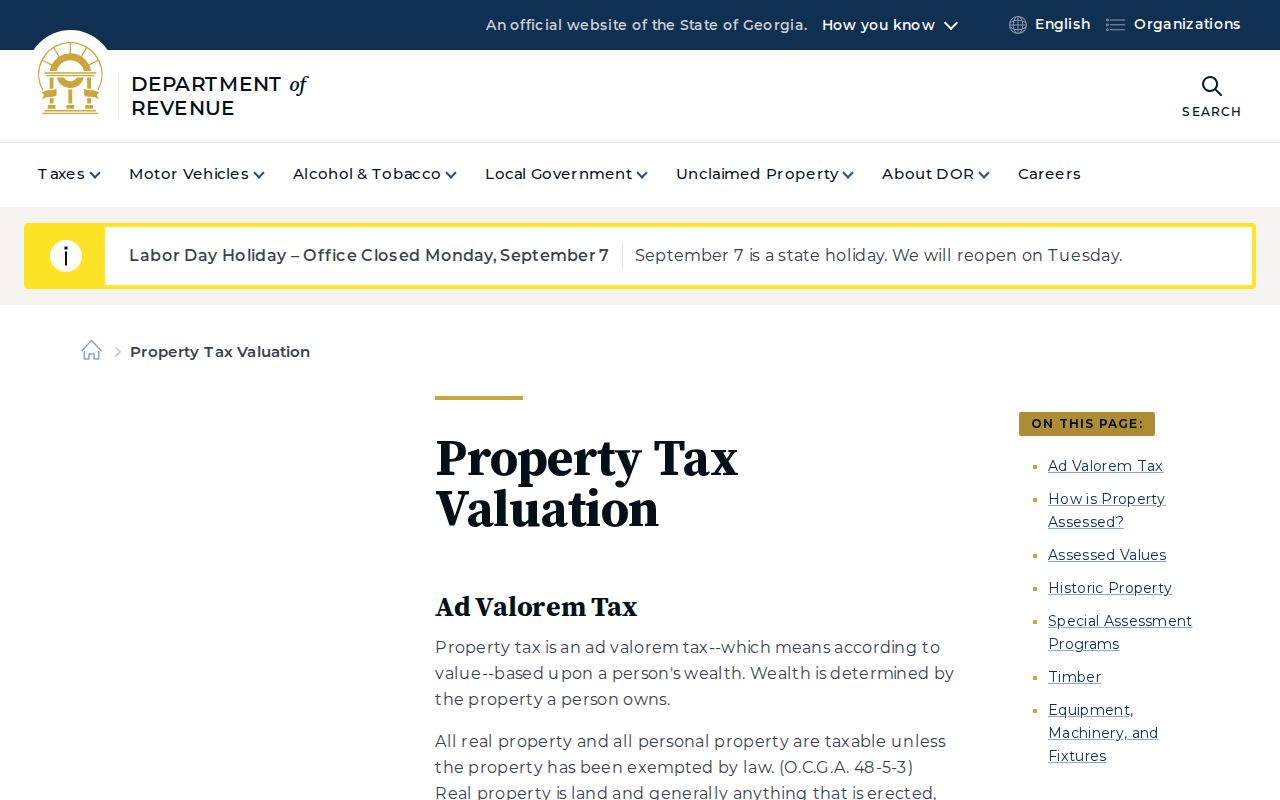
Read the assessment ratio and appeal routes alongside Morgan's current notice, since the notice carries the parcel-specific values and the deadline.
Two Morgan Offices, Two Different Records
The Board of Assessors sits at 150 East Washington Street, Suite 130, in Madison. It handles valuation, ownership-transfer maintenance, parcel data, exemptions, current notices, field reviews, and appeals. The Tax Commissioner occupies Suite 140 and handles bills, collections, delinquencies, and the search-and-pay route. A newly recorded deed can appear before qPublic catches up. Morgan publishes no fixed assessor-roll refresh interval. Record the source year and date rather than forcing records from different cycles to agree.
Both offices also take direct questions when a portal is unclear. The Assessor answers at 706-342-0551 during posted weekday hours, and the Tax Commissioner at 706-342-0464. Bring the exact parcel number and tax year. Ask the Assessor about value, parcel facts, transfers, exemptions, notices, or appeals; ask the Tax Commissioner about a bill, payment, balance, delinquency, or tax sale. For bill and payment work online, the Tax Commissioner's official site is the source route.

Use it after identifying the parcel and tax year in the assessment record, then preserve the payment status the account displays.
Look Up a Morgan County Tax Bill
Start with the official qPublic parcel search to pin down the right parcel. Then move to the Tax Commissioner's GovernmentWindow search-and-pay portal. The static official material publishes no exact live tax-search labels. So follow the fields the portal shows. Preserve the bill or account identifier it returns.
- Find the qPublic parcel by address, owner, parcel number, or legal information.
- Copy the parcel number into the Tax Commissioner search and select the intended tax year.
- Read the billed amount, payment status, balance, exemptions, and net assessed value.
- Compare those fields with the assessment notice for the same year.
- For delinquency or sale questions, confirm the status directly with the Tax Commissioner and search later recorded instruments at the Clerk.
- Assessed value
- The statutory fraction of fair-market value used before exemptions.
- Millage
- The annual rate applied per $1,000 of taxable assessment.
- Homestead exemption
- Qualifying relief associated with an owner's principal residence.
- Tax lien
- A legal claim arising from unpaid property tax; search related filings and releases.
Track Morgan Bills, Due Dates, and Delinquency
The Morgan Tax Commissioner's FAQ covers real-property taxes. It sets November 15 as the normal due date. Late unpaid balances draw 1% monthly interest and a 10% penalty within 90 days. The page states a homestead-liability exception for bills under $500. Levy action can follow. Amounts and status change. Work from the current account and ask the Tax Commissioner to confirm any payoff figure. A delinquent bill is not itself the tax-sale deed. Follow any sale, redemption, and eventual deed through the responsible office and the Clerk.
Check Morgan Homestead and Specialized Exemptions
The Assessor runs regular homestead, senior, disabled-veteran, surviving-spouse, Conservation Use, FLPA, and Historic Properties programs. Other specialized programs are described on its pages too. The local homestead page keeps April 1 timing language. The state DOR's 2026 page describes an application change tied to a 45-day appeal window. Those published directions differ. Verify the current deadline with the Assessor and the notice before relying on either summary. Then check whether the exemption actually appears on the parcel and bill.
An exemption is not automatic proof that every annual bill is right. Confirm the exemption class and the application year. Confirm the ownership and occupancy requirements the office describes. Also confirm the amount actually deducted from assessed value. Conservation, forest-land, historic-property, veteran, and surviving-spouse programs each carry their own qualifications and documentation. Rely on the current Morgan forms and an office determination. Do not infer eligibility from age, land use, or a prior owner's record.
Why Morgan Assessor Data May Change
The Assessor reports routine on-site reviews under O.C.G.A. §48-5-264.1(a). A review can follow an owner request. It can also follow permitted or unpermitted work, a use or zoning change, an appeal, or a data correction. Staff should carry identification, and the county page describes a white county truck. A site review updates assessment facts. It does not decide title or replace a recorded deed.
Trace a Morgan Delinquency Beyond the Bill
The online tax account shows one thing for a given year. It tells you whether a charge is due or paid. That is all it tells you. It cannot prove a tax sale happened or that ownership passed. Before going further, write down the parcel, the year, the balance, and the status. Then take those details to the Tax Commissioner and ask about levy or sale records. The Clerk's office comes next. A tax deed and any later instruments live in the deed records there. Watch for a redemption period too. An unpaid status, an advertised sale notice, and a recorded tax deed are distinct stages of the same delinquency, not interchangeable proof.
Keep Morgan Assessment and Bill Years Aligned
Dates rarely line up. A value on qPublic can carry one date, and an annual assessment notice, a tax bill, a sale, and a deed recording can each carry another for the same property. Build one row per tax year in Morgan County. List fair-market value, assessed value, exemptions, net taxable value, millage, the billed amount, and payment status. Give the transfer date its own column. With that layout, an apparent discrepancy often turns out to be plain timing. Morgan publishes no fixed schedule for closing-to-roll updates. Date labels beat any assumption that every system refreshes at once.
Older tax material takes a different path. The Morgan Archives holds tax digests among its collections. Ask by year, owner, district, land description, or digest citation. A broad request for a whole family or property history will only slow things down. A historic digest can hand you an owner-and-value lead, but it never transfers title. Modern street addressing came late in many eras. Confirm the tract through deeds, plats, and estate records.
Appeal a Morgan County Assessment
Every Morgan County appeal starts with the annual assessment notice. Read its values and deadline first. Georgia law, including O.C.G.A. §48-5-311, opens several routes. Options include the Board of Equalization, a hearing officer, or arbitration, depending on the property and the issue at hand. File through the Morgan Board of Assessors in the manner the notice describes. Strong evidence helps. It includes a correct parcel description, photographs, comparable sales, an appraisal, and records showing errors in acreage or improvements. Keep value appeals and tax-payment disputes separate, because they go to different offices. Preserve everything. Keep the notice, the envelope or delivery evidence, the filed appeal, supporting exhibits, and any confirmation. State plainly which value or factual field is contested and what correction you want. A neighboring parcel can serve as a comparison. It works only when its characteristics and valuation year genuinely match yours. Keep handling the tax bill as instructed, too. Filing an assessment appeal does not erase separate billing obligations.
Use the notice deadline. Morgan County's current assessment notice controls the filing window. Contact the Board of Assessors promptly because a generic calendar date can be wrong for the present cycle.