
Follow Morgan County's Owner-Finding Route
Begin with the county's official Morgan County Parcel Info page. That gateway opens the free, countywide qPublic database. The goal is a linked chain: address, parcel number, legal description, assessor entry, and the most recent recorded conveyance.
- Search the situs address and save the parcel number, legal description, owner field, mailing address, and search date.
- Search that owner as grantee in the Morgan Clerk or GSCCCA index and match the land description.
- Compare the newest recording date with the qPublic record date; document any mismatch instead of guessing.
- For an LLC, trust, or estate, preserve the role shown and check the proper entity or probate source.
File the details, not just the name. Keep the instrument type, grantor, grantee, book and page, and recording date with any owner result so another reader can reproduce the same check.
Compare Morgan County Property Owner Sources
Each office lists an owner for its own reason. The Morgan County assessor ties a parcel to a taxpayer for valuation, the Clerk of Superior Court records the conveyances, and the plat supplies geographic context. A dependable answer draws on all three.
| Source | Owner Info It Gives | Access |
|---|---|---|
| qPublic assessor roll | Owner field, mailing address, situs, parcel and legal clues | Free official route; no fixed refresh interval is published |
| Clerk / GSCCCA index | Recorded grantee, grantor, deed type, date, book/page | Use the newest matching recorded deed |
| Secretary of State | Entity record and registered agent | Free business search; agent is not the titled owner |
| Public Property Record map | Parcel shape and nearby geographic context | Map and roll may refresh on different schedules |
A mailing address only shows where the tax bill goes. It may belong to an entity, trustee, estate, agent, or an owner living far from Morgan County, while the situs address identifies the assessed property itself.
- Owner of record
- The name an official roll or instrument associates with the parcel.
- Grantee
- The person or entity receiving the interest stated in a deed.
- Title
- The legal interest, which a tax card or index result alone does not adjudicate.
- Situs
- The property location, distinct from the mailing destination.
Read Morgan's Assessor Name as a Starting Point
Morgan County's qPublic site is the right discovery tool for an owner search. Standard Georgia qPublic interfaces offer four lookup modes. You can query by owner, location address, parcel number, or legal information. Morgan's own labels and required fields may differ. Record the interface exactly as it appears when you search. A solid result carries more than the owner field. Expect a parcel number, situs and mailing addresses, legal description, assessment notice, sales clues, value fields, and a map link. Save the query and the result date. If qPublic is unavailable, fall back on the Clerk's deed index. Search it by name and legal description. Ask the Assessor rather than trusting a third-party summary.
Note: A blank or stale result is a routing problem to investigate. It is not proof that the land has no owner of record.
Use Morgan's Official Owner Search Entry
Morgan County's Parcel Info gateway is the official doorway for an owner search.
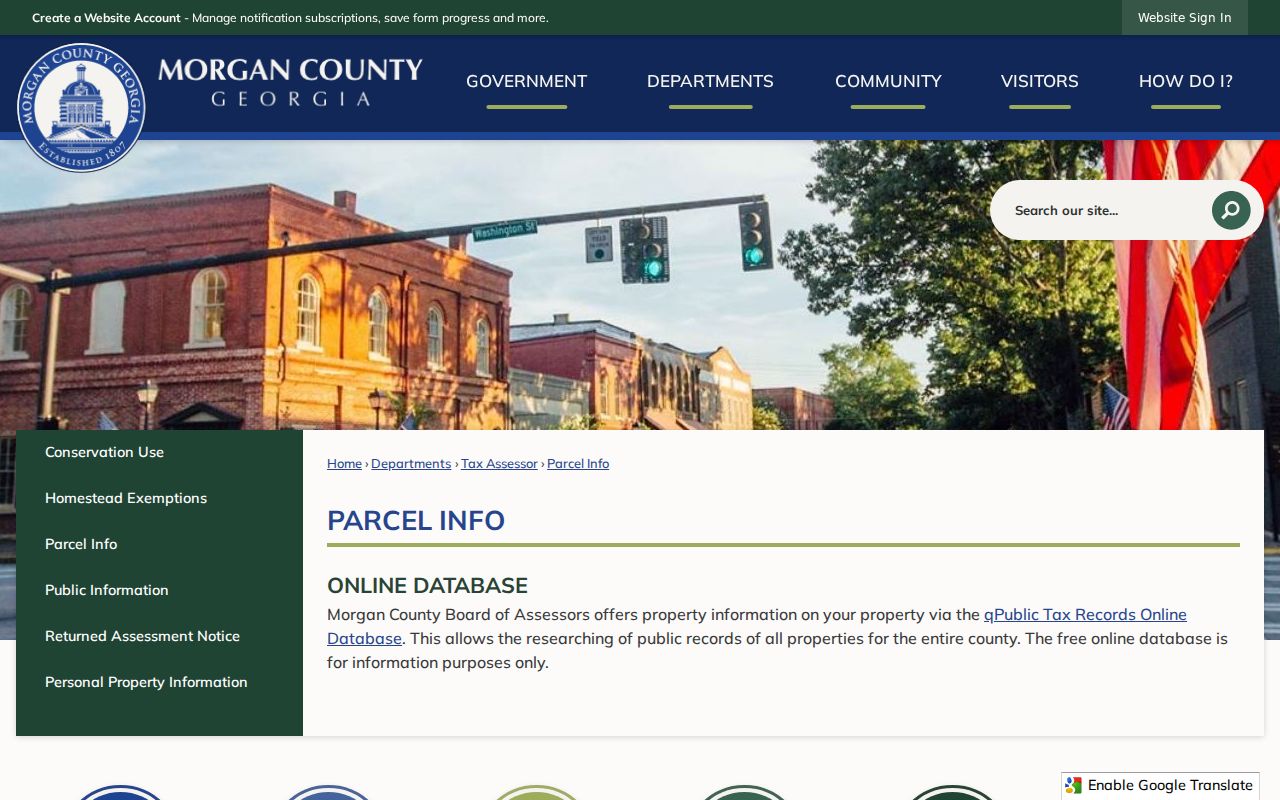
The county page separates its own guidance from the hosted qPublic result. If the live card will not load, keep this source bookmarked, call the Assessor, and turn to the Clerk's deed records to confirm ownership.
Confirm the Morgan Owner With a Recorded Deed
Treat the apparent owner as a lead, not a conclusion. Search that name as a grantee in the GSCCCA Real Estate Index. Or use the Morgan Local Land Search. Narrow the results to Morgan County. Then match subdivision, lot, acreage, district, land lot, road, and any prior book/page clues you already hold. A shared name alone proves nothing. Watch the timing, too. A recorded deed can beat the assessment roll into the files. So a tax bill still showing the old owner of record does not undo a newer conveyance. Morgan County publishes no standard closing-to-roll delay. So rely on actual deed dates instead of guessing at a lag. The latest matching deed is stronger evidence than an unchanged tax roll name. Though neither replaces a professional title examination.
Decode Morgan LLC, Trust, and Estate Ownership
Entities change the game. When the owner of record is an LLC, trust, or estate, search the exact recorded spelling first. Then try common punctuation variants. The Georgia Secretary of State Business Search handles queries by business name, control number, registered agent, or officer. It offers starts-with, contains, and exact-match modes. Remember that a registered agent is a contact point, not automatically the landowner. Keep trustee language attached to the trust itself. For an estate, Morgan Probate Court records may document an executor's or administrator's authority. The deed still carries the actual conveyance. Heirs, beneficiaries, contractors, tax-mail recipients, and personal representatives all play real roles in property records. But none of them should be relabeled as the owner without a deed that says so.
Use Morgan Permit Records to Locate Hard Parcels
A permit file can crack a stubborn parcel search. When a street address is incomplete, Morgan County's land-disturbance application still asks for the project address, nearest cross-street, tax map, parcel, acreage, owner, and contractor. Those fields lead to the assessor record. The applicant is not always the titled owner. Contractors often differ from the deed's owner of record. City limits matter as well, since Madison runs its own building and planning functions while Morgan County Planning handles county permits, inspections, licensing, enforcement, and zoning through OpenGov. A Madison, Bostwick, Buckhead, or Rutledge mailing address does not by itself establish municipal jurisdiction.
Monitor Morgan County Filing Alerts
The Clerk links to the free Filing Activity Notification System. FANS can alert a registered user to later filings. These can be tied to a name or property address. It helps after you identify who owns a parcel. Its own terms disclaim completeness, accuracy, and fraud prevention. Treat an alert as a prompt to inspect the actual instrument. It proves no fraud. Use public owner and address information for legitimate property work. Do not republish sensitive details.
Document Morgan County Ownership So It Can Be Checked
Write down what you searched and what came back. A good ownership worksheet lists the search mode and any spelling you tried. It also lists the parcel number, situs, mailing address, legal description, and the owner field exactly as displayed. Add the source date. Note the parties on the latest deed, the recording date, and the book and page. Consider whether the answer came from an official portal, a recorded image, or an office response. If two sources disagree, keep both and explain the date or description gap. The Morgan County current-owner guide covers what the tax roll shows today; former owners call for a backward deed chain. Either way, the paper trail leads to an answer you can defend.
Try Morgan County Name and Address Variants
An exact street spelling can fail even when the parcel exists. Try variations. Add or drop the street direction, swap the suffix, test a route number or a historic alias. Switch to parcel or legal-description mode. Save the first query so later attempts do not erase your original evidence. On a rural tract, a house number matters less than acreage. Nearest cross-street, road references, and adjoining owners count more. Those clues often carry a Morgan County search further than a street address ever will. Names deserve the same patience. Run surname and given name, initials, married-name variants, exact entity spellings, and trust wording. Test punctuation changes too. Narrow broad results with the situs, mailing address, parcel number, or legal description. Never assume a shared surname means the same owner of record.
Use Morgan County Offices When Online Search Stops
Online Morgan County property records only go so far. The Board of Assessors keeps parcel and valuation data. The Clerk of Superior Court's Real Estate Division records deeds and plats. Web links may connect the two offices, but their jobs stay distinct. The Clerk's Records Room at 384 Hancock Street in Madison welcomes free research. Printed copies cost money. Staff will not perform legal research for you. A record may exist but not be posted online. In that case, a focused Georgia Open Records Act request can name the parcel, address, record type, office, and date range. A narrow request routes faster than one asking an office to decide who owns land. Ask for the records first and draw a cautious conclusion from their dates and stated fields.
Know What a Morgan County Owner Lookup Cannot Tell You
Every owner lookup has limits. A Morgan County property owner result does not prove who lives at the address, resolve an unrecorded claim, interpret an easement, or fix a legal boundary. Georgia law shields certain records and residence details. Respect those protections rather than working around a lawful confidentiality measure.
Lawful use. An assessor name is not a title opinion, and a mailing address is not occupancy proof. Never use Morgan County owner information to stalk, harass, threaten, or harm anyone.
Some questions outgrow an index. For a purchase, an estate, a fraud concern, or a contested interest, pull the recorded documents and get suitable professional review. The public index finds records. It does not decide the legal issue. A parcel map cannot establish title or lawful access either, so when the answer turns on a boundary, easement, probate order, or unreleased lien, gather that separate evidence and label whatever question remains.