
Begin a Morgan County Property Records Search
The county's official Parcel Info page routes searchers to qPublic for countywide assessment records. That is the practical first stop. The parcel card joins an owner display, situs and mailing addresses, a legal description, values, exemptions, sale information, a current notice, and a map link. From there the trail splits by question.
The Clerk's deed index tests the ownership clue, the Tax Commissioner answers billing questions, and planning files explain permitting or zoning. Official Morgan County property records document what each custodian maintains as of a particular date. Keep the limits straight. A parcel card is not the deed, and a tax value is not a sale prediction. A digital parcel line is not a survey.
Start broad when only a name is known. Search spelling variants in qPublic, then compare mailing address, situs, legal description, and map position before selecting a parcel. Trusts, estates, and companies need the exact entity name. Run punctuation-free variants as well. Never substitute a registered agent or mailing contact for the titled owner. Rural land works differently. Use the nearest cross-street, acreage, tax map number, road variants, and legal-description language when the address fails.
Keep a dated research log. Record each query, result URL, parcel or account number, tax year, recording date, instrument type, book/page, and any conflicting fields. Assessment notices, deeds, bills, permits, and court filings run on different calendars. A discrepancy is not always an error. A reproducible log shows whether it reflects a stale roll, a new transfer, a different tax year, or the wrong parcel.
- Search qPublic by address, owner, parcel number, or legal information.
- Save the exact parcel number and legal description, then find the newest deed in the Clerk/GSCCCA index.
- Check the Tax Commissioner's account for the same tax year, bill, payment, and delinquency status.
- Use the parcel map for geographic context and the recorded plat or survey for boundary evidence.
- Order certified copies or request non-indexed records from the responsible custodian.
The Offices Behind Morgan County Property Records
Three Madison offices divide the core work. The Clerk records conveyances and encumbrances, the Assessor establishes value and maintains parcel data, and the Tax Commissioner bills and collects. Aim each question at the right office. The Tax Commissioner cannot change an assessment, and the Assessor's owner field never replaces a deed.
Morgan County Clerk of Superior Court
384 Hancock Street
Madison, GA 30650
706-342-3605
Morgan County Board of Assessors
150 E Washington St, Suite 130
Madison, GA 30650
706-342-0551
Morgan County Tax Commissioner
150 E Washington St, Suite 140
Madison, GA 30650
706-342-0464
Read the Morgan qPublic Parcel Card
Morgan's qPublic interface supports owner, location-address, parcel-number, and legal-information search modes. Search broadly at first. Then preserve the exact parcel number, both addresses, owner label, legal description, tax district, values, exemptions, sale references, map link, and current assessment notice. The Assessor posts the notice below parcel values. Morgan County says so expressly.
| Situs | The physical property location. |
|---|---|
| Mailing | Where tax correspondence goes; not proof of occupancy. |
| Parcel number | The cross-system key, including all letters, zeroes, and punctuation. |
| Owner field | An assessment-roll clue to verify against the newest recorded deed. |
The county's Parcel Info landing page is the official handoff into that workflow.
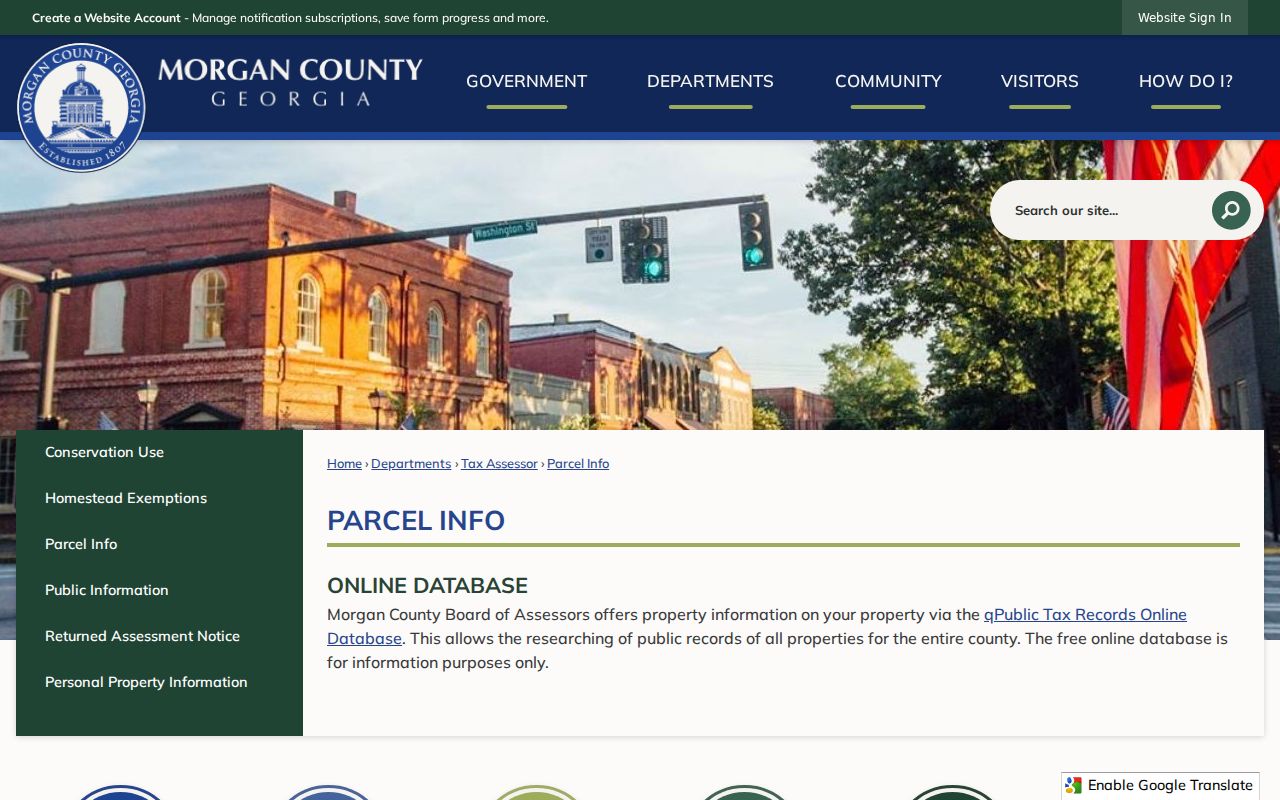
Use its qPublic link, then save the parcel identifiers returned.
Morgan Values Property at Georgia's 40% Ratio
Georgia DOR explains that assessed value is generally 40% of fair-market value. Morgan's tax formula then subtracts exemptions. Annual millage applies to the net assessed value. One mill equals one dollar per $1,000 of assessment. These figures answer tax questions; they do not equal a deed's consideration or predict a sale price, and the Assessor sets value while the Tax Commissioner issues the bill.
Compare Morgan's 1806 Deed Lead With GSCCCA
The Clerk maintains deeds and images going back to 1806, historical index books covering 1806-1833, plats beginning in 1921, and liens starting in 2003. The GSCCCA statewide index, meanwhile, offers county indexes reaching back at least to January 1, 1999. Those claims do not conflict. They simply describe two different access systems for Morgan County deed records. GSCCCA lets you search by party, property, book and page, date, and instrument type. For anything older or more detailed, turn to the local land search, the Records Room, or the Archives. That is where the deeper property records live.
When online searching fails, take the parcel's description and citation to the Clerk's Records Room at 384 Hancock Street. Self-directed research is free. Printed copies are paid. Staff do not perform legal research, and Morgan Archives can help with older deeds, land titles, tax digests, wills, and estates. Its posted hours conflict, so call ahead. For a certified modern instrument, the Clerk links GSCCCA eCertification, and the Clerk's Real Estate page documents Morgan's local holdings and access paths.
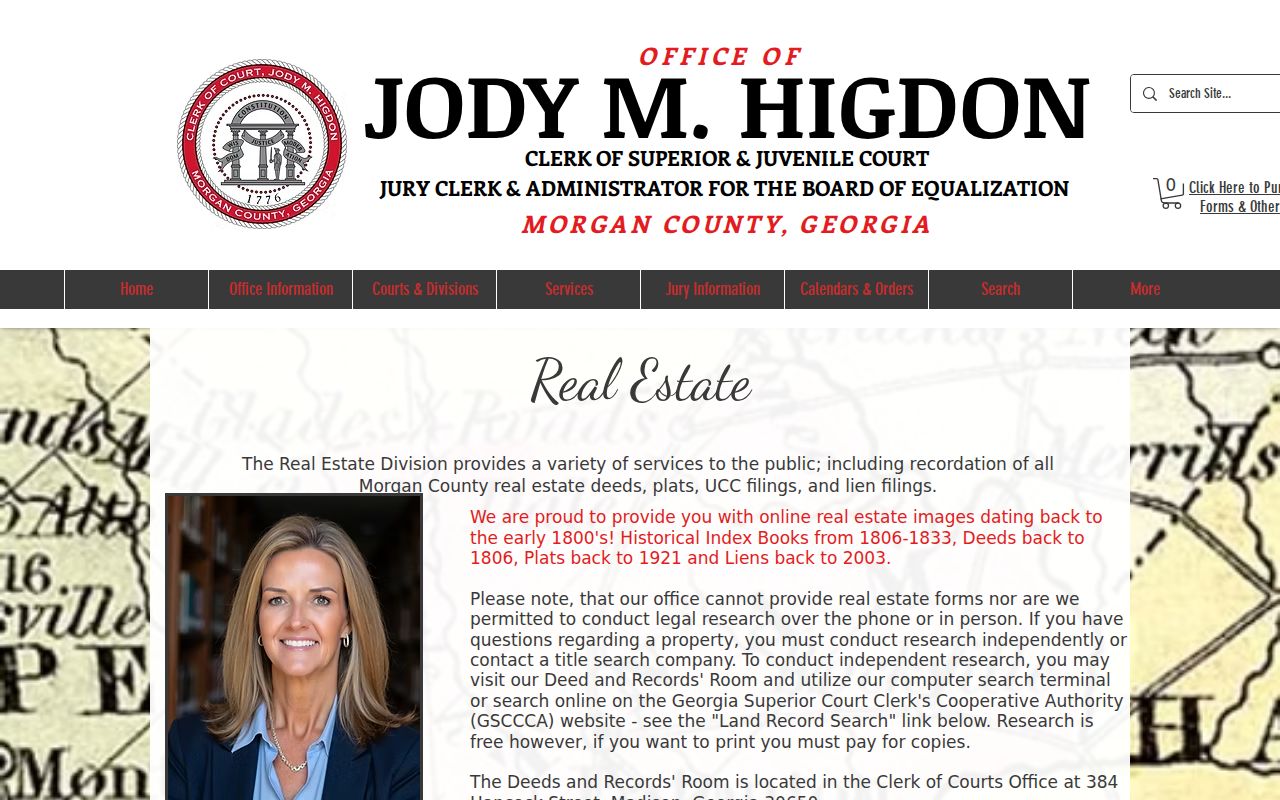
The page draws a line between free self-directed research and paid printed copies, and it routes users to the applicable land-record systems for each type of request.
Match Morgan County Property Records to the Question
Every record set has a limited role. In Morgan County, combining them builds a stronger answer without mistaking a tax, map, permit, or court entry for a conveyance.
| Record Type | What It Documents | Kept By | Access |
|---|---|---|---|
| Deeds | Recorded transfers, parties, legal descriptions | Clerk of Superior Court | GSCCCA, Kofile, Records Room |
| Liens and security deeds | Recorded encumbrances and later releases | Clerk | Real-estate index |
| Assessment and tax | Values, exemptions, notices, bills, payments | Assessor / Tax Commissioner | qPublic / GovernmentWindow |
| Plats and parcels | Lot, road, easement, and map context | Clerk / Assessor / Planning | Plat index and qPublic map |
| Permits and zoning | Applications, inspections, reviews, decisions | County or city planning office | OpenGov, city pages, request |
For a chain and copy workflow, use the detailed Morgan County deed records guide. The property tax records guide covers assessment and billing. The parcel map guide adds GIS and plat context.
Use Morgan Maps as Clues, Not Legal Boundaries
Morgan County routes its tax maps, aerials, and parcel information through the assessor's Public Property Record map. The county offers no separate open-data viewer. That single portal is the practical starting point. GIS standards adopted in 2005 spell out how spatial data supports valuation and planning, with a clear caution that digital lines are not legal boundaries. Treat any map line as a clue. For a true boundary answer, pull the recorded plat and read the deed references and easements. Hire a Georgia surveyor when the stakes are legal.
Carry Older Morgan Research Beyond the Portal
The Morgan County Archives keeps early deeds, land titles, wills, estates, and tax digests. Older books anchor deep research. The Georgia Archives holds Surveyor General plats covering 1755 to 1909, helpful when early district and land-lot language predates modern roads or even Morgan County's 1807 formation. Digitized Morgan newspapers from 1842 to 1878 add estate, sheriff-sale, road, and property-name leads. Verify every clue in the deed book. The 1917 courthouse fire makes custody checks sensible. It does not prove that every older record burned.
Build an older chain backward from the newest reliable description. Search the present grantee first. Copy the prior grantor with its book and page. Then search that grantor as an earlier grantee. At each step compare acreage, district, land lot, subdivision, roads, adjoining owners, and cited plats. Correction deeds, quitclaims, survivorship deeds, administrator deeds, sheriff deeds, foreclosure deeds, and tax deeds can all branch a chain. A plain buyer-seller list misses such turns. A modern parcel may come from a split or combination. It may never appear under its current parcel number in the older books.
The Georgia Archives loose-plat collection and Surveyor General material add original grant and land-lot context. The Morgan Historical Society helps too. A Madison bibliography offers architectural and local-history leads. The newspaper collection surfaces former names and sale notices. Context identifies a place. The legal conclusion still rests on the recorded chain, court or probate authority, releases, and plats. Any professional title or survey work also carries weight. Keep those layers separate.
Monitor Morgan Property Filings With FANS
The Clerk's FANS information page lets owners set filing alerts by name or property address. An alert is only a nudge. The service disclaims accuracy, completeness, and fraud prevention. Open the recorded document itself. If a filing looks suspicious, contact the Clerk rather than treating the alert as proof of fraud.
Connect Morgan Parcels to Permit and Zoning Files
Morgan County Planning & Development handles permits, inspections, licensing, and code enforcement. It also handles planning or zoning applications through OpenGov. The land-disturbance form captures the essentials. It records jurisdiction, project address, nearest cross-street, tax map and parcel, acreage, owner, and contractor. Those fields can reconnect a planning file to the assessment parcel. That helps when a rural street number is incomplete. Major land disturbance has stated triggers. The county counts at least one acre. It also counts work within 200 feet of state waters, or a newer subdivision. Verify current classifications with the office.
Jurisdiction must come first. Madison runs its own building-permit and planning functions inside city limits. County processes apply outside. A Madison, Rutledge, Bostwick, or Buckhead mailing address proves nothing about incorporation. Find the parcel. Settle jurisdiction. Then request the application, staff report, inspection history, and final decision from the right custodian.
OpenGov applications are dynamic and may require an account for status or payment. A missing file is not the end. Ask for the application, submitted survey, staff review, inspection record, corrections, and final disposition by parcel and date range. Madison City Clerk handles requests for city-held material separately. Bostwick and Rutledge packets show why a deed and Georgia-surveyor plat often accompany a planning request. The planning decision itself still transfers no ownership.
Follow Morgan Estate Records to a Conveyance
A Probate Court file can identify an estate, its executor or administrator, a will, an inventory, and any authority over land. A probate mention is not a deed. Take the estate number and representative's name to the Clerk and search for an administrator or executor deed. Match the legal description next. A death record supports identity and date research. It cannot decide title. When a chain jumps from a deceased owner to an heir or purchaser, inspect probate orders, survivorship language, and the recorded conveyance before concluding anything.
Morgan Probate Court is the county route for estates and wills. Georgia DPH supplies statewide death-record access under its own eligibility and redaction rules. Ask only for what connects estate to land. An inventory can mention property without conveying it. A will can state an intention that later administration changes. Record the estate number, representative, court order, deed date, grantee, and description. Treat each as a separate evidence point.
Separate Morgan Foreclosure, Tax Sale, and Lien Signals
A delinquent tax account, mortgage foreclosure notice, lis pendens, code case, and abandoned-property registration are different records. An abandoned-property registration is a different record too. Do not blur them. Start with the Tax Commissioner for bill status. The Clerk's real-estate index covers deeds, liens, releases, and security instruments. Superior Court holds a related civil docket. Morgan's foreclosure-information program targets creditor compliance for abandoned or foreclosed property. It is not an ownership list. Confirm any completed transfer through the recorded deed. Check redemption or release documents where they apply.
Request Missing Morgan Files From the Custodian
When an index does not list the file you need, go straight to the source. Morgan County accepts open-records requests for permit histories, code files, planning letters, and other unindexed material. Submit these through its county request form. List the department. Note the record type, the parcel or address, the date range, and the format you want. Georgia's Open Records Act, O.C.G.A. §50-18-70 et seq., sets the clock. The county generally must respond within three business days. That applies when the records are not on hand. Otherwise it must explain any delay, cost, or exemption. Search and redaction fees may apply, so verify current charges first.
The form asks for a detailed description, contact information, a signature, and the date. It separates access from copies and offers an electronic-copy option plus a sheriff-record branch. Morgan County posts ten cents per black-and-white letter or legal page. Color pages and maps can cost more. Confirm the rate before placing a large order. Narrow wording cuts retrieval and redaction time. If the county withholds material, the response should name the statutory exemption. Georgia shields certain sensitive categories even when the rest of the property file is public. Request any segregable portion and avoid republishing protected identifiers. A public owner field is evidence about a record, not permission to target a person.
Limits of Morgan County Property Records
Property records answer many questions, but not all of them. A Morgan County file can show the assessor's owner field, the recorded grantee, a legal description, values, exemptions, tax status, liens, plats, permits, and court or estate clues. It cannot guarantee clear title. It cannot establish an unrecorded interest. It cannot mark a surveyed boundary, prove occupancy, or predict a sale price. Updates also arrive on different schedules. Morgan publishes no fixed lag between a closing and the assessor roll. So a new deed may reach the recorder before the qPublic owner change appears.
Lawful use. Morgan County property records support due diligence, boundary research, appeals, estate work, history, and civic transparency. Do not use public owner or address information to stalk, harass, or harm anyone.