
Read Morgan County Deed Records by Instrument
Deeds, plats, liens, and UCC filings all pass through the Morgan County Clerk of Superior Court Real Estate Division. A deed names the parties, describes the land, and places the conveyance in the public record. The instrument type shapes the questions you ask next, since it signals what was transferred and which branches still need checking.
| Deed Type | What It Does | Common Use |
|---|---|---|
| Warranty deed | Conveys the stated interest with deed covenants | Ordinary arm's-length transfer |
| Quitclaim deed | Conveys whatever interest the grantor has, if any | Interest cleanup or intra-family change |
| Correction deed | Corrects stated information in an earlier instrument | Name or description correction |
| Administrator or executor deed | Conveys under estate authority | Probate-linked transfer |
| Sheriff, foreclosure, or tax deed | Records a transfer arising from a legal process | Distressed-property chain |
A security deed or lien encumbers property rather than conveying it outright. Do not treat an encumbrance as resolved on assumption. It is resolved only after finding its cancellation, release, satisfaction, assignment, or court disposition. Follow the paper, not the assumption. Log each deed fully. Record the county, instrument type, and date. Add the grantor, grantee, and consideration if visible. Include the legal description, subdivision or district with land lot, book and page, prior-deed reference, image availability, and any exceptions or releases. That inventory keeps a familiar party name from standing in for the right tract. It also makes every later property search reproducible.
Inside Morgan's Real Estate Records Room
The Records Room sits at 384 Hancock Street in Madison. The Clerk reports deed and image depth back to 1806, historical index books covering 1806 through 1833, plats from 1921, and liens from 2003. Research there costs nothing. Printed copies do. Staff will not supply real-estate forms or run legal research by phone or at the counter, so bring names, an approximate date, a book and page, and land-description clues already gathered. The statewide standardized index promises deed-index data for all counties to January 1, 1999. Morgan's 1806 claim describes local holdings only. It does not mean every early record is searchable in the same modern interface.
Call the Clerk at 706-342-3605 if the access route or copy procedure seems unclear. Frame any question around custody, though, not title. Ask staff to locate a record, not to interpret one. A strong request names Morgan County, the parties, the instrument type, an approximate recording date, and a citation. The Clerk handles records access. A title professional, attorney, or surveyor supplies whatever legal analysis your project needs.
Search Morgan Deeds in Two Indexes
Two indexes cover Morgan County deed research. The Clerk links both the GSCCCA Real Estate Index and Morgan Local Land Search. The Kofile platform routes users through a login and subscription. GSCCCA, by contrast, allows county, region, and statewide searching. Images there are tied to account access, and applicable charges apply.
| Search mode | Useful input | Expected output |
|---|---|---|
| Party | Grantor, grantee, person, business, trust | Party and instrument candidates |
| Property | Subdivision, unit, block, lot | Property-index matches |
| Book/page | County citation from a deed or parcel card | Direct instrument and image route |
| Date/type | Date range, party role, instrument type | Narrowed chain results |
| Geography | Morgan County or wider region | Reduced same-name noise |
The local Morgan land-search workspace provides the county-specific route.
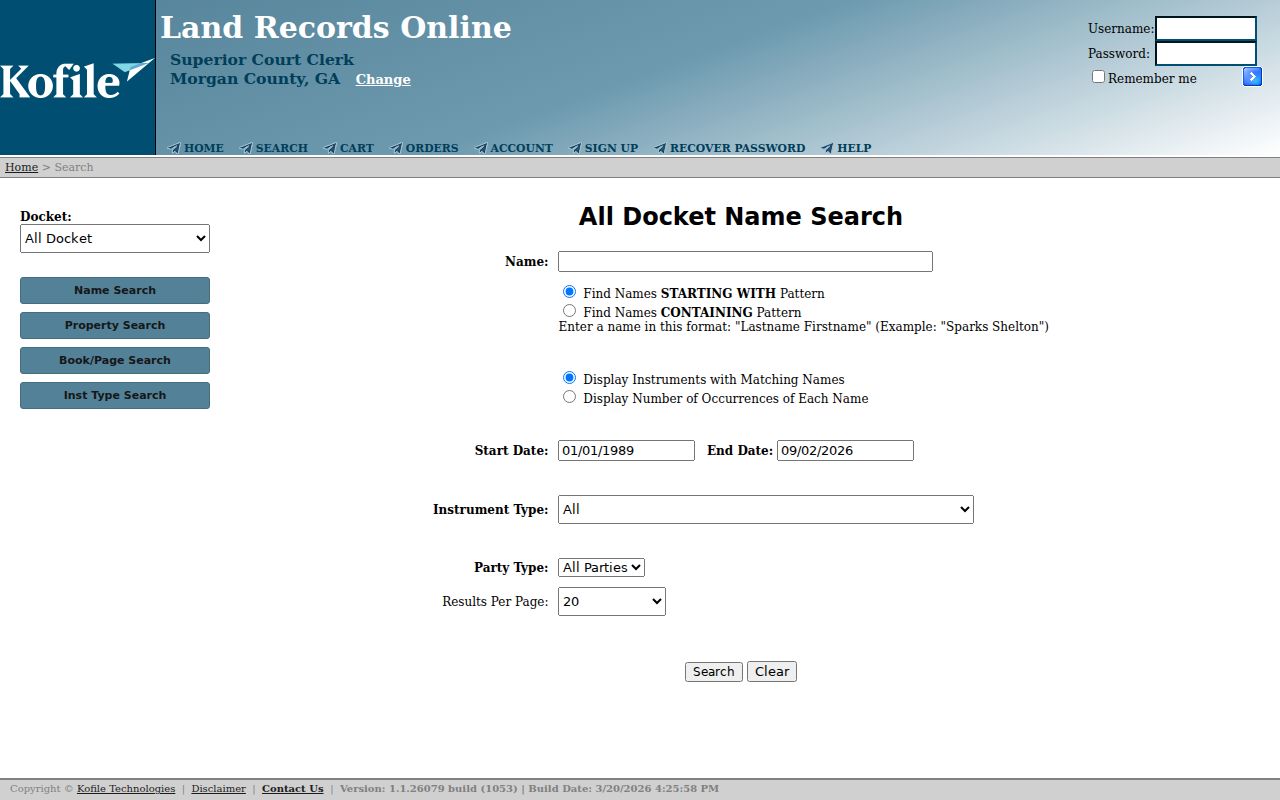
That account gateway is worth remembering. Bring a book and page citation, confirm access terms, and skip the disappointment of a locked image.
Walk the Morgan Grantor-Grantee Index Backward
Rebuild a chain one transaction at a time. Match the legal description at every step. A familiar name alone proves little without the same lot, acreage, land lot, or adjoining-owner clues.
- Find the newest purchase deed by searching the current candidate owner as grantee.
- Record its grantor, grantee, date, deed type, legal description, and book/page.
- Search that grantor as a grantee in an earlier date range and verify the same land.
- Repeat through prior-deed references; branch for estates, corrections, survivorship, sheriff, or foreclosure instruments.
- At an index cutoff, continue in the local deed books, Morgan Archives, or Georgia Archives land records.
- Grantor
- The party transferring the stated interest.
- Grantee
- The party receiving the stated interest.
- Chain of title
- The linked sequence of conveyances for the same land.
- Book/page
- The recorded citation used to locate an indexed document or image.
Pair Morgan Deeds With Plats and Easements
A Morgan plat can answer questions a deed alone cannot. It shows lot and block numbers, streets, rights-of-way, easements, drainage, common areas, and adjoining parcels. Search terms worth trying include subdivision name and phase. Also try surveyor, developer, replat, vacation, dedication, and plat book and page. Remember one limit, though. A plat identifies land. But it does not prove who the current owner of record is unless it is incorporated into a conveyance or a legal title conclusion. County planning files may also hold a survey or plat tied to a zoning or land-disturbance application.
Tracing a subdivision chain takes patience. Start with the plat citation in the deed. Copy the exact subdivision, unit or phase, and lot and block. Then read the dedications and easements drawn on the plat itself. Test any later replats, vacations, and right-of-way instruments against that baseline. Acreage tracts demand a different comparison set: district, land lot, acreage, metes-and-bounds calls, roads, and adjoining owners. A parcel number can change after a split or combination. The recorded description preserves the chain's land identity.
From 1806 Deed Books to the Statewide Index
Morgan County was cut from Baldwin County in 1807. That means the earliest land trail can predate the county's own record. The Morgan County Archives holds early deeds, land titles, estates, wills, and tax digests. Georgia Archives' Surveyor General plats span 1755-1909 and can bridge an original grant to its district and land-lot description. Local history also notes a 1917 courthouse fire. Don't assume every earlier deed burned. Ask the Clerk or Archives which original, copy, reconstructed, or surviving books remain on the shelf.
Digitized Morgan newspapers from 1842-1878 add another layer, yielding sheriff-sale, estate, road, and property-name clues. Treat newspaper text as a lead only. Verify it in the deed book or court file, never as the conveyance itself.
The statewide GSCCCA Real Estate Index supplies the complementary modern search route.
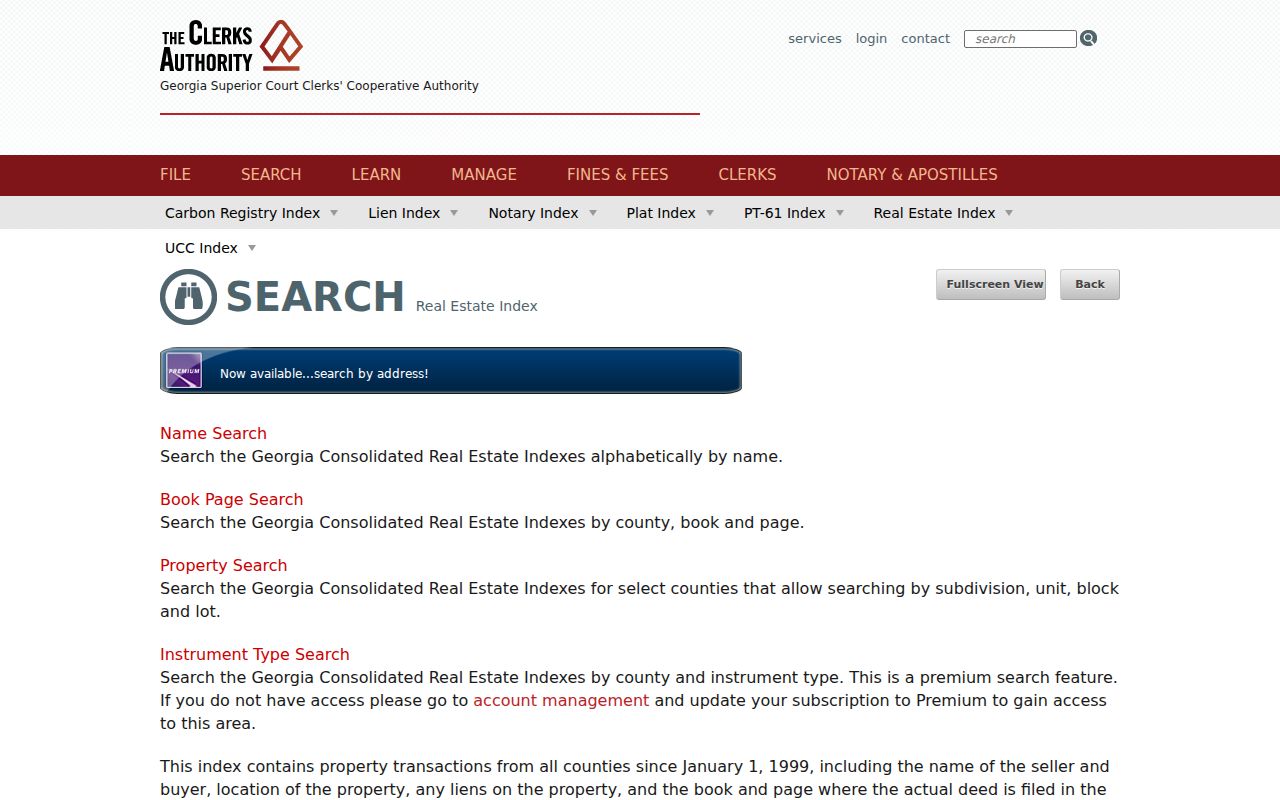
The statewide index earns its keep. Its county, party, property, date, type, and citation filters let you narrow an instrument before you order an image or a certified copy.
Monitor New Morgan Filings With FANS
Georgia runs a service called the Filing Activity Notification System. The Clerk's office links to it for Morgan County users. FANS sends alerts when a new filing matches a name or property address you register. That can tip off an owner of record quickly. The system itself warns that it promises no accuracy, completeness, or fraud prevention. So pull the actual deed or lien before drawing conclusions. Call the Clerk if an entry looks wrong.
Recognize Estate and Court Branches in a Morgan Chain
Estate paper can trip up a deed chain. An administrator or executor deed in Morgan County rests on authority. That authority is granted by Morgan Probate Court. A sheriff, foreclosure, or tax deed may instead depend on a court order. It may also rest on a published notice, a sale record, or a redemption trail. Note the estate or case number whenever one appears. Then go back to the Clerk's real-estate index. Look there for the instrument that truly describes the land and the grantee. Survivorship language can shift the route yet again. These branches show why a surname-only chain can skip a transfer. That can hold even when the parcel never moved an inch.
A chain sometimes stops at a deceased owner. The Morgan Probate Court file may reveal the will, the estate representative, the inventory, or the authority behind a later conveyance. Treat a death record as an identity and date lead only. It is not proof that anyone owned land. A civil docket or foreclosure notice works the same way, pointing toward supporting facts rather than replacing the recorded deed. Always tie the estate or case back to the legal description and the final instrument in the Morgan County deed records.
Verify Every Morgan Deed by Its Land Description
Names make weak identifiers. Match the subdivision and lot, the unit or phase, the district and land lot, the acreage, the road reference, the metes-and-bounds calls, the adjoining owners, and any prior deed cited. Match the subdivision and lot. Confirm the unit or phase and the district and land lot. Check the acreage, the road reference, and the metes-and-bounds calls. Note the adjoining owners and any prior deed cited. A correction deed may fix a name while the land stays the same. Or it may repair the land description itself. A quitclaim conveys only what the grantor actually held. Log every exception, reservation, easement, and plat reference instead of reducing each deed to buyer and seller. Log every exception and reservation. Note each easement and plat reference rather than reducing each deed to buyer and seller. That habit keeps a same-name instrument on a different Morgan tract from contaminating the chain.
Obtain a Morgan County Deed Copy
Take the index citation and pull the image through an available portal. You can also request a printed copy from the Clerk's Records Room, or order an electronic certified copy through GSCCCA eCertification. Viewing and printing may call for an account or a per-page charge. Check the current Clerk fee schedule first. For mail or counter requests, supply Morgan County, the parties, the instrument type, the recording date, and the book and page. A plain research copy and a certified copy serve different purposes. State which one you need. An index entry with no ready image does not mean the deed is missing. Check the other Clerk-linked portal. Search the book and page locally. Ask the Records Room whether an older volume or image exists. Morgan Archives opens another channel for nineteenth- and early twentieth-century land material. Preserve the source of every copy. An index abstract, an unofficial image, and a certified copy carry different evidentiary weight.
Recorded, not guaranteed. Morgan County deed records show instruments accepted for recording, not a legal conclusion that title is clear. Unrecorded interests, probate issues, liens, easements, and description defects may require professional review.